
Table of Contents
How Artificial Intelligence Is Transforming Ethical Wildlife Research, Monitoring, and Protection
Introduction: Why AI Matters for Wildlife Conservation
Wildlife conservation is facing unprecedented challenges. Habitat loss, climate change, illegal wildlife trade, human–wildlife conflict, and declining biodiversity are accelerating at a global scale. Conservationists are required not only to act faster but also to make better, data-driven decisions—often with limited resources and in complex environments.
In this context, AI in wildlife conservation has emerged as one of the most powerful and promising tools of the 21st century. Artificial Intelligence (AI) enables conservationists to process vast amounts of ecological data, detect patterns invisible to the human eye, predict threats, and monitor wildlife populations in ways that were impossible just a decade ago.
However, AI is not a magic solution. Its use in conservation must be ethical, transparent, non-invasive, and aligned with ecological realities. When applied responsibly, AI can significantly enhance conservation outcomes while minimizing harm to wildlife.
This article provides a comprehensive, research-oriented exploration of AI in wildlife conservation—covering technologies, real-world applications, ethical considerations, limitations, and future directions.
What Is Artificial Intelligence in Wildlife Conservation?
Defining AI in a Conservation Context
Artificial Intelligence refers to computational systems that can perform tasks typically requiring human intelligence, such as:
- Pattern recognition
- Image and sound classification
- Prediction and forecasting
- Decision support
In wildlife conservation, AI is used to analyze ecological data, monitor species, and support conservation decision-making—not to replace ecologists, but to amplify their capabilities.
Key AI Technologies Used in Conservation
- Machine Learning (ML) – Learns patterns from data
- Deep Learning – Advanced neural networks for complex recognition
- Computer Vision – Interprets images and videos
- Natural Language Processing (NLP) – Analyzes text and reports
- Predictive Modeling – Forecasts risks and trends
Why AI Is Needed in Modern Conservation
The Scale Problem in Wildlife Protection
Conservation challenges today involve:
- Millions of camera trap images
- Continuous satellite data streams
- Thousands of acoustic recordings
- Decades of historical ecological data
Human teams alone cannot process this scale of information efficiently. AI helps bridge this gap.
Reducing Human Impact on Wildlife
One of the most important benefits of AI in wildlife conservation is reduced physical disturbance:
- Fewer field intrusions
- Less animal handling
- Remote monitoring of sensitive species
This aligns perfectly with ethical and NGO-driven conservation principles.
Core Applications of AI in Wildlife Conservation
1. Wildlife Monitoring and Population Estimation
AI systems can automatically identify and count animals from:
- Camera trap images
- Drone imagery
- Satellite photos
This reduces manual labor and improves accuracy.
Examples:
- Counting migratory birds at wetlands
- Estimating ungulate populations in savannas
- Monitoring endangered species in remote habitats
2. AI and Camera Traps
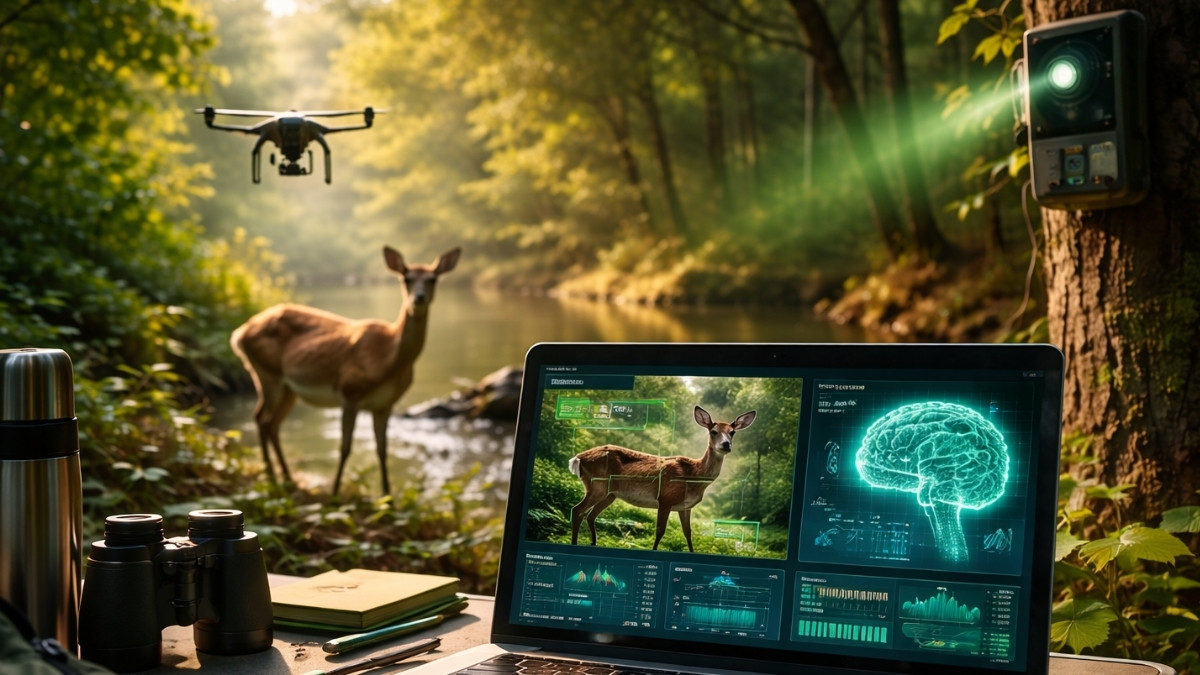
Camera traps generate millions of images—most of which contain no animals.
AI helps by:
- Filtering empty images
- Identifying species automatically
- Classifying behavior (feeding, resting, moving)
This dramatically speeds up research workflows.
3. AI in Drone-Based Wildlife Research
When combined with drones, AI becomes even more powerful:
- Automatic species detection from aerial images
- Behaviour classification from movement patterns
- Habitat-behaviour relationship analysis
For migratory birds, this allows ethical observation without ground disturbance.
4. Acoustic Monitoring and Bioacoustics
AI analyzes sound recordings to detect:
- Bird calls
- Frog choruses
- Bat echolocation
- Illegal gunshots or chainsaws
This is particularly valuable in dense forests and at night.
5. Predicting Human–Wildlife Conflict
AI models can predict where and when conflict may occur by analyzing:
- Animal movement data
- Crop patterns
- Human settlement expansion
This enables preventive conservation, not reactive responses.
AI for Migratory Bird Conservation
Migratory birds are among the most threatened wildlife groups due to habitat loss across flyways.
How AI Supports Migratory Bird Research
- Tracking migration timing shifts due to climate change
- Identifying key stopover sites
- Detecting threats along migration routes
- Analyzing flock behavior from drone footage
For species like cranes, AI supports flyway-level conservation planning—something traditional methods struggle to achieve.
Ethical Use of AI in Wildlife Conservation
Why Ethics Must Come First
AI systems can unintentionally cause harm if:
- Sensitive location data is exposed
- Surveillance is misused
- Communities are excluded
- Wildlife stress is ignored
Ethical AI is not optional—it is essential.
Core Ethical Principles
1. Non-Invasive First
AI should reduce handling, tagging, and disturbance—not increase it.
2. Data Sensitivity
Endangered species locations must be protected from poachers.
3. Transparency
Models and limitations must be openly documented.
4. Human Oversight
AI supports decisions; it must not replace ecological judgment.
AI, NGOs, and Conservation Organizations
How NGOs Use AI
- Anti-poaching patrol optimization
- Habitat change detection
- Conservation impact evaluation
- Policy support with evidence-based insights
AI allows NGOs to do more with limited funding—but only when capacity building and training are included.
Limitations and Risks of AI in Conservation
Technical Limitations
- Biased training data
- Errors in species identification
- Limited generalization across ecosystems
Conservation Risks
- Over-reliance on algorithms
- Loss of local ecological knowledge
- Technology inequality between regions
Responsible conservation balances AI with field expertise.
Integrating AI with Other Conservation Technologies
AI is most powerful when combined with:
- Drones – Aerial data collection
- GIS – Spatial analysis
- Satellite Remote Sensing – Large-scale monitoring
- Community Science – Ground validation
This integrated approach defines modern conservation science.
Future of AI in Wildlife Conservation
Emerging Trends
- Real-time AI monitoring systems
- Edge AI on drones and sensors
- Open-source conservation AI models
- Global ethical AI frameworks
The future lies not in more technology—but in better, more responsible technology.
Best Practices for Using AI in Conservation Projects
- Start with a conservation question—not a tool
- Involve ecologists from the beginning
- Test models locally before scaling
- Protect sensitive data rigorously
- Publish methods and ethics transparently
Why WildlifeTechHub Advocates Ethical AI
WildlifeTechHub promotes AI as a support system for conservation, not a replacement for nature or human responsibility. Ethical AI aligns technology with compassion, science, and sustainability.
AI in wildlife conservation must serve biodiversity—not exploit it.
Frequently Asked Questions (FAQ)
What is AI in wildlife conservation?
AI in wildlife conservation refers to the use of artificial intelligence tools to monitor, analyze, and protect wildlife and ecosystems ethically.
Is AI harmful to animals?
AI itself is not harmful. Harm arises from unethical implementation or misuse.
Can AI replace field biologists?
No. AI supports researchers but cannot replace ecological understanding and field expertise.
Is AI affordable for small NGOs?
Yes, especially with open-source tools and partnerships.
How does AI help migratory birds?
AI analyzes migration patterns, threats, and habitat changes across large flyways.
Is AI legally regulated in conservation?
Regulation varies by country; ethical self-governance is essential.
What data does AI use in conservation?
Images, audio recordings, satellite data, GPS data, and environmental variables.
Conclusion: AI as a Tool for Coexistence
AI in wildlife conservation represents one of the most powerful opportunities to protect biodiversity—if guided by ethics, science, and humility. When used responsibly, AI helps humanity understand nature better, act faster, and cause less harm.
The future of conservation is not just intelligent—it must also be ethical.